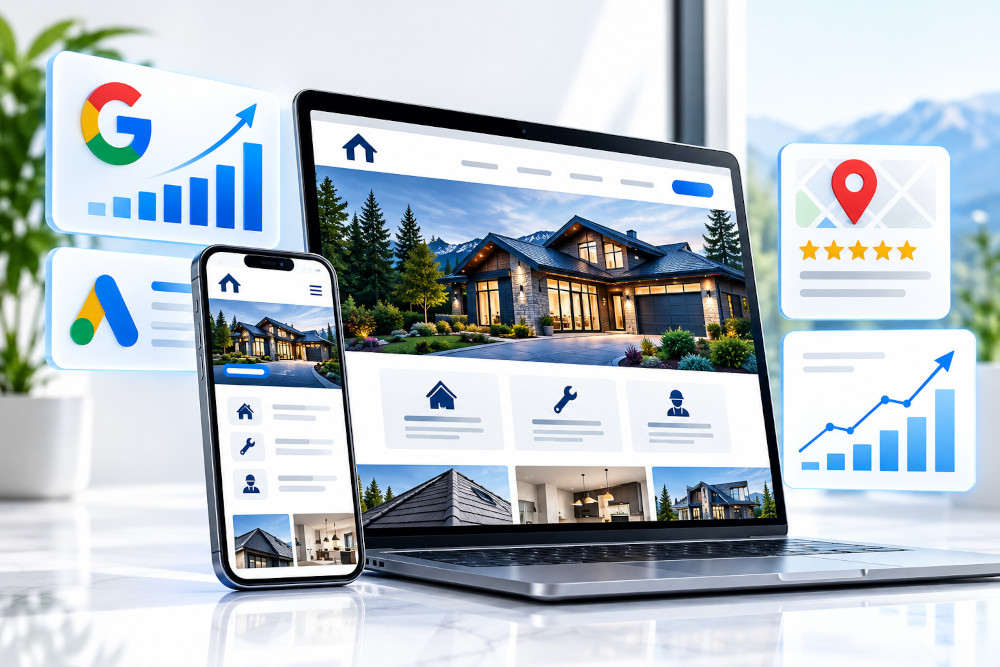
How to Improve Your Local Google Rankings: 12 Effective SEO Strategies
If your business depends on attracting customers in a specific city or service area, improving your local Google rankings should be a priority.
When someone searches for “roofing contractor Vancouver,” “emergency plumber near me” or “water damage restoration Burnaby,” Google displays businesses it considers most relevant to that search.
Appearing prominently in these results can help your business attract qualified website visitors, generate customer inquiries and compete more effectively in your local market.
But how do you improve your local Google rankings?
The answer involves more than adding keywords to your website. Successful local SEO combines an optimized Google Business Profile, relevant service pages, customer reviews, website performance and a strong online reputation.
In this guide, we’ll explain how Google ranks local businesses and outline 12 practical strategies to improve your visibility in Google Search and Google Maps.
How Google Determines Local Search Rankings
Google uses three primary factors to determine local search rankings: relevance, distance and prominence.
Understanding these factors is essential when developing a local SEO strategy.
Relevance
Relevance measures how closely your business matches a customer’s search.
For example, a roofing company with detailed information about roof repairs is more likely to be considered relevant to someone searching for that service.
Accurate business categories, descriptive service pages and relevant website content help establish relevance.
Distance
Distance considers how far a business is from the location associated with a search.
A customer searching for a plumber in Burnaby may see different results than someone performing the same search in Richmond.
While businesses cannot control proximity to every customer, accurate location information helps Google understand where they operate.
Prominence
Prominence reflects how established and well-known a business appears to be.
Google considers information such as customer reviews, backlinks and references to your business across the web.
Building a strong online reputation can help improve this aspect of local search visibility.
Google explains these factors in its official local ranking guidelines.
1. Optimize Your Google Business Profile
Your Google Business Profile is one of the most important components of local SEO.
It allows your company to appear in Google Maps and local search results while displaying essential information, including your phone number, website, business hours and customer reviews.
Start by ensuring your profile contains accurate, complete information.
Important elements include:
- Your actual business name.
- Primary and secondary business categories.
- Business address or service-area settings.
- Phone number and website.
- Current operating hours.
- Business description.
- Relevant services.
- Genuine business photographs.
Choose Accurate Business Categories
Your primary category should describe your core business.
For example, a roofing contractor should generally select a roofing-related category rather than a broad construction category.
Secondary categories can describe additional legitimate services.
Avoid adding unnecessary keywords to your business name or selecting unrelated categories to manipulate rankings.
Keep Your Profile Updated
Review your profile whenever your business information changes.
Upload relevant photographs of completed projects, your team and your operations.
For contractors and home service businesses, authentic project photographs can help prospective customers evaluate your work.
A complete, accurate Google Business Profile helps establish relevance and makes your business easier to contact.
2. Research Local SEO Keywords
Local keyword research identifies the search terms customers use when looking for businesses like yours.
For service businesses, valuable keywords often combine a service with a location.
Examples include:
- Roofing contractors Vancouver.
- Emergency plumber Burnaby.
- Water damage restoration Surrey.
- Electrician Coquitlam.
- Home renovation contractors Richmond.
These searches demonstrate local intent and often indicate that someone is actively evaluating service providers.
Prioritize Commercial Search Intent
Consider the difference between two searches:
“How long does a roof last?”
This is primarily informational. The person may be researching roofing materials or maintenance.
“Roof replacement contractor Vancouver”
This suggests the person may be looking to hire a roofing company.
Both keywords can be valuable, but commercial searches are generally more directly connected to customer acquisition.
Use keyword research to identify relevant services, geographic markets and customer questions.
Prioritize keywords based on business value, search intent and competition rather than search volume alone.
3. Create Dedicated Service Pages
One of the most effective ways to improve your website’s organic visibility is to create dedicated pages for your primary services.
Many businesses make the mistake of listing every service on a single page.
While this provides a general overview, individual service pages allow you to explain each offering in greater detail.
Example: Roofing Contractor Website
A roofing company might organize its website around:
| Service Page | Suggested URL |
|---|---|
| Roof Installation | /roof-installation/ |
| Roof Replacement | /roof-replacement/ |
| Roof Repairs | /roof-repairs/ |
| Metal Roofing | /metal-roofing/ |
| Roof Maintenance | /roof-maintenance/ |
Each page should explain what the service involves, common customer problems, available solutions and how to request an estimate.
Include original project photographs and practical examples whenever possible.
Avoid Duplicate Content
Every service page should provide distinct value.
For example, roof replacement and roof repair pages should address different customer needs rather than repeat the same information with slightly different keywords.
A logical website structure helps search engines understand your services while making it easier for customers to find relevant information.
For businesses planning a new website, professional WordPress web design can establish an SEO-friendly foundation from the beginning.
4. Optimize Your Website’s On-Page SEO
On-page SEO helps search engines understand the content and purpose of individual webpages.
Important elements include page titles, headings, URLs, meta descriptions and image descriptions.
Write Descriptive Page Titles
Your SEO title should clearly communicate the page’s primary topic.
For example:
Roof Repair Services in Vancouver | ABC Roofing
This identifies the service, geographic market and business.
Structure Your Headings
Use one clear H1 heading that describes the page’s main topic.
Organize supporting information with relevant H2 and H3 headings.
For example:
- H1: Roof Repair Services in Vancouver
- H2: Common Roofing Problems We Repair
- H2: Emergency Roof Leak Repairs
- H2: Our Roof Repair Process
- H2: Request a Roof Repair Estimate
Optimize URLs and Images
Keep URLs short and descriptive.
For example:
example.com/roof-repairs/
Use meaningful image file names and alternative text that accurately describes each image.
Avoid forcing keywords into headings, paragraphs or image descriptions.
Effective on-page SEO makes your content easier for both customers and search engines to understand.
5. Build Useful Location Pages
Businesses serving multiple communities may benefit from dedicated location pages.
For example, a roofing contractor operating throughout Metro Vancouver might create pages for Vancouver, Burnaby, Richmond, Coquitlam and Surrey.
However, each page should provide meaningful information specific to that location.
Useful content might include:
- Services available in the community.
- Local project examples.
- Relevant service considerations.
- Geographic coverage.
- Customer questions.
- Contact information.
Example: Roofing Services in Burnaby
A useful Burnaby roofing page could explain the company’s services in the community, showcase completed projects and address common roofing concerns relevant to local properties.
It should not simply duplicate the Vancouver page with the city name replaced.
Google discourages doorway pages created primarily to capture similar searches without providing distinct value.
Build location pages for customers, not just search engines.
6. Generate Genuine Google Reviews
Customer reviews influence both local search visibility and purchasing decisions.
Google confirms that review count and positive ratings can contribute to local rankings.
For contractors and service businesses, reviews also provide valuable social proof.
Ask Customers for Feedback
After completing a project, invite customers to share their experience.
A simple follow-up message might say:
“Thank you for choosing our company. We’d appreciate it if you could share your experience in a Google review.”
Include a direct review link to make the process convenient.
Do not offer incentives or selectively request reviews only from satisfied customers.
Respond to Reviews
Thank customers for positive feedback and respond professionally to negative reviews.
Address legitimate concerns without disclosing private information.
A consistent review management process helps maintain your company’s reputation and demonstrates professionalism to prospective customers.
7. Earn Relevant Local Backlinks
Backlinks are links from other websites pointing to yours.
They can help search engines discover your content and contribute to your website’s authority.
For local businesses, relevant links from established organizations and industry sources can be valuable.
Potential opportunities include:
- Local chambers of commerce.
- Industry associations.
- Professional organizations.
- Supplier directories.
- Community partnerships.
- Local publications.
For example, a roofing contractor might earn a link from a legitimate construction association or roofing material supplier.
Focus on building relationships and earning relevant links.
Avoid purchasing large quantities of low-quality backlinks or participating in link schemes intended to manipulate rankings.
Link quality and relevance matter more than simply accumulating large numbers of backlinks.
8. Improve Website Speed and Mobile Performance
Many customers search for local services using smartphones.
Someone dealing with a plumbing emergency or roof leak may want to find a phone number and contact a contractor immediately.
If your website loads slowly or is difficult to navigate, you risk losing that opportunity.
Make Your Website Mobile-Friendly
Ensure your website includes:
- Readable text.
- Responsive layouts.
- Simple navigation.
- Clickable phone numbers.
- Clear contact buttons.
- Easy-to-use inquiry forms.
Improve Loading Speed
Common performance improvements include compressing images, enabling caching, reducing unnecessary scripts and using reliable hosting.
Google’s Core Web Vitals measure loading performance, responsiveness and visual stability.
While strong performance scores do not guarantee higher rankings, a fast, accessible website provides a better customer experience.
Ongoing WordPress maintenance and support can help maintain website performance, security and reliability.
9. Strengthen Your Internal Linking Structure
Internal links connect related pages within your website.
They help customers discover relevant information while allowing search engines to understand your website’s structure.
For example, a roofing website might connect:
Roofing Services → Roof Repairs → Emergency Roof Repairs
A blog article about identifying roof leaks could also link to the company’s roof repair page.
Connect Blog Content to Services
Consider these examples:
| Blog Article | Relevant Service Page |
|---|---|
| Signs Your Roof Needs Replacement | Roof Replacement |
| Common Causes of Basement Flooding | Water Damage Restoration |
| When to Replace a Water Heater | Water Heater Installation |
| Benefits of Metal Roofing | Metal Roofing |
Use descriptive anchor text that explains where a link leads.
Avoid excessive linking or repeatedly using identical keyword-rich anchor text.
A logical internal linking structure supports website navigation and helps important pages remain discoverable.
10. Publish Helpful, Industry-Relevant Content
Blog articles can help your website attract customers researching services before making a purchasing decision.
For construction and home service companies, useful topics often involve costs, maintenance, repairs and project planning.
Examples include:
- How Much Does a New Roof Cost in Vancouver?
- What Causes Low Water Pressure in a House?
- What to Do After a Basement Flood.
- When Should You Upgrade Your Electrical Panel?
- How Much Does a Kitchen Renovation Cost?
- Heat Pump vs. Furnace: Which Is Better?
Demonstrate Real Experience
Whenever possible, include original photographs, project examples and practical industry knowledge.
For example, a roofing contractor could explain common roofing problems encountered in coastal British Columbia.
A restoration company could describe the typical process of assessing water damage.
Original experience helps distinguish your content from generic articles.
Google’s SEO Starter Guide emphasizes creating helpful, reliable content for people rather than search engines.
Publishing useful information is more important than meeting an arbitrary posting frequency.
11. Maintain Accurate Business Listings
Your business information should remain accurate across relevant online platforms.
Important listings may include:
- Google Business Profile.
- Bing Places.
- Apple Business Connect.
- Industry directories.
- Local business associations.
- Professional organizations.
Review your business name, address, phone number, website and operating hours.
Correct outdated information where possible.
For service-area businesses without a public storefront, follow each platform’s requirements for displaying or hiding business addresses.
Avoid submitting your company to hundreds of unrelated directories.
Prioritize legitimate platforms that customers actually use.
12. Track Your Local SEO Performance
Improving local Google rankings requires ongoing measurement.
Without reliable data, it’s difficult to determine which strategies are producing results.
Google Search Console
Google Search Console provides information about your website’s organic search performance.
Monitor:
- Search impressions.
- Organic clicks.
- Search queries.
- Average search positions.
- Page indexing.
Use this information to identify successful pages and opportunities for improvement.
Google Analytics 4
Google Analytics helps you understand how visitors interact with your website.
For service businesses, useful conversions include contact form submissions, quote requests and tracked phone interactions.
Google Business Profile Performance
Google Business Profile provides information about how customers discover and interact with your listing.
Review available metrics such as calls, website clicks and search interactions.
Measure Leads, Not Just Rankings
A roofing contractor ranking for “roof replacement Vancouver” may generate more commercial value than attracting thousands of visitors searching for unrelated information.
Your SEO strategy should ultimately support qualified inquiries, booked estimates and acquired customers.
Combining organic visibility with effective lead generation strategies helps connect website traffic with measurable business outcomes.
Common Local SEO Mistakes to Avoid
Even established businesses make mistakes that limit their local search visibility.
Incomplete Google Business Profiles: Missing categories, outdated hours and inaccurate contact information make it harder for customers to find your business.
Keyword Stuffing: Repeating keywords excessively creates unnatural content without providing meaningful value.
Duplicate Location Pages: Publishing nearly identical pages for multiple cities can create low-value content.
Ignoring Customer Reviews: Failing to encourage genuine feedback can weaken your online reputation.
Poor Mobile Experience: Slow pages, difficult navigation and complicated forms discourage prospective customers.
Weak Internal Linking: Important service pages may be difficult for customers and search engines to discover.
Ignoring Conversion Tracking: Rankings and traffic provide limited business insight without measuring inquiries and customer acquisition.
Avoiding these mistakes creates a stronger foundation for sustainable local SEO growth.
How Long Does It Take to Improve Local Google Rankings?
There is no guaranteed timeline for improving local search rankings.
Results depend on your website’s current visibility, local competition, geographic market, business reputation and the quality of your SEO improvements.
Some changes, such as correcting inaccurate business information, can be implemented immediately.
Other improvements, including developing website authority and earning stronger rankings in competitive markets, may take several months or longer.
Local SEO should be treated as an ongoing investment rather than a one-time task.
Consistent optimization, useful content and performance monitoring provide a more sustainable approach than short-term ranking tactics.
Frequently Asked Questions About Local SEO
How can I improve my local Google rankings for free?
Start by optimizing your Google Business Profile, improving your service pages, maintaining accurate business information and encouraging genuine customer reviews. Google Search Console and Google Analytics also provide free performance monitoring tools.
How do I rank higher on Google Maps?
Focus on maintaining an accurate Google Business Profile, selecting relevant categories, building a strong online reputation and providing useful business information. Google primarily evaluates relevance, distance and prominence when ranking local businesses.
Do Google reviews help local SEO?
Yes. Google confirms that review count and positive ratings can contribute to local search rankings. Genuine reviews also help prospective customers evaluate your business.
Do I need a website to rank on Google Maps?
An eligible business can appear on Google Maps through its Google Business Profile without a website. However, a professional website provides additional opportunities to attract organic traffic, explain services and generate customer inquiries.
Is local SEO better than Google Ads?
Local SEO focuses on building organic search visibility over time, while Google Ads provides paid advertising placements. Both can be valuable, and many businesses benefit from combining them.
How often should I update my website for SEO?
Update your website whenever information changes or meaningful improvements are needed. Review important service pages periodically and publish useful content when appropriate. Google does not require a specific publishing frequency.
Improve Your Local Google Rankings and Grow Your Business
Improving local Google rankings requires a coordinated approach to website optimization, Google Business Profile management, customer reviews and online authority.
Start by ensuring your business information is accurate and your website clearly explains the services you provide.
Build useful service pages, target relevant local keywords and create content that answers real customer questions.
Strengthen your online reputation through genuine reviews, relevant backlinks and consistent business information.
Finally, monitor your performance and focus on turning search visibility into qualified customer inquiries.
The ultimate goal of local SEO isn’t simply to rank higher on Google. It’s to help more of the right customers discover your business and choose your services.
Get Found. Generate Leads. Grow Your Business.
LET’S IMPROVE YOUR LOCAL VISIBILITY
Ready to attract more local customers? Erikson Media helps construction, trades and service businesses improve search visibility, generate qualified inquiries and build stronger digital foundations.
From local SEO and professional websites to lead generation and intelligent automation, we provide solutions designed to support long-term business growth.